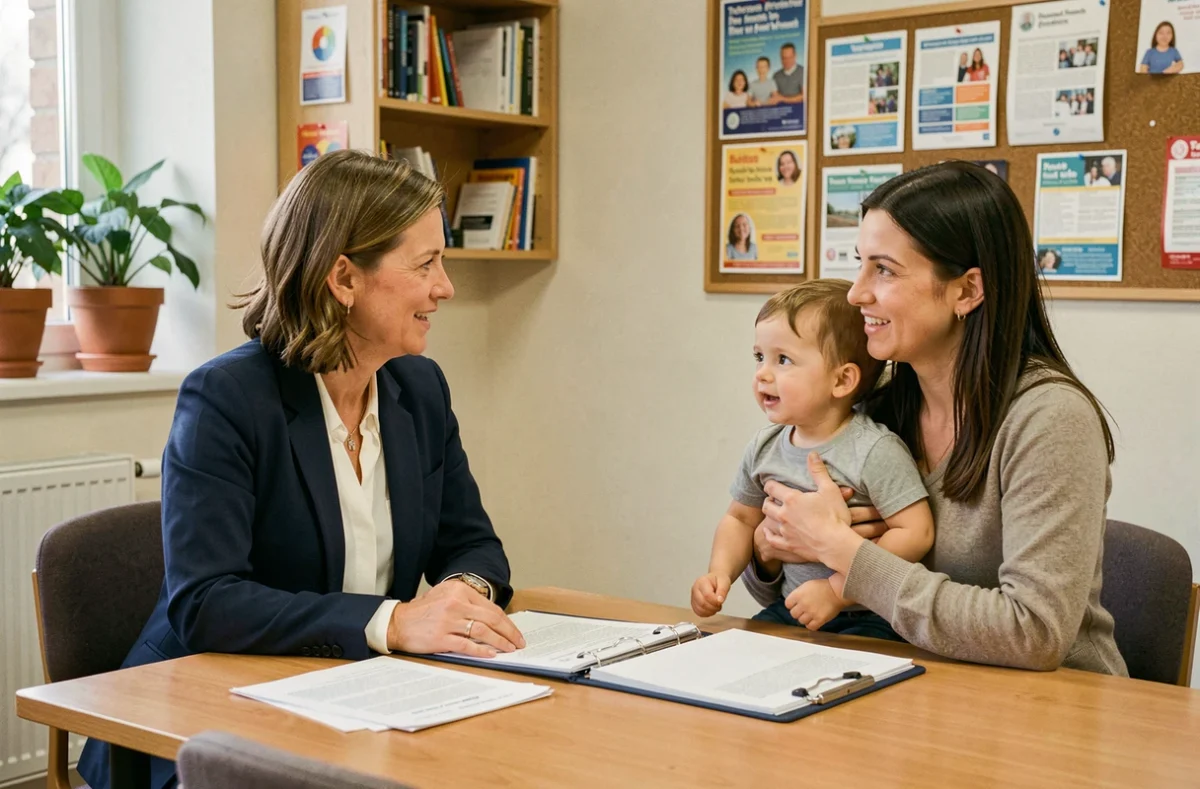
Family support systems have undergone a structural shift since January 1, 2025. The transfer of the responsibility for organizing childcare for young children to municipalities reshapes the landscape of services available to families. This change in governance profoundly alters how parents access information, childcare options, and parenting support services.
Municipalities as organizing authorities: what the law changes for full employment
The law for full employment now assigns three operational missions to municipalities: assessing the needs of families with young children, informing and guiding parents, and planning the development of childcare options in their territory. This triptych shifts the responsibility from national oversight to local management.
In practice, this decentralization requires local authorities to produce an updated territorial diagnosis. Local elected officials become the direct contacts for families regarding all matters related to childcare services, where the CAF and PMI previously handled most of the guidance.
We observe that this reform creates a leverage effect for territories already equipped with a dense associative network, but it risks exacerbating disparities in areas where engineering resources are lacking. Families located in rural intercommunalities with low administrative capacity do not access the same level of service as those in metropolitan areas, and learning more about CCOPF family helps to better understand the coordination mechanisms between institutional and associative actors at the local level.
Mobile services and access to rights in rural areas
Concentrating parenting support services in fixed locations mechanically excludes families far from urban centers. The development of mobile services addresses this gap in territorial coverage.

The Family Bus, deployed in Eure-et-Loir by Udaf 28, illustrates this outreach logic. The service targets three areas: access to rights, parenting support, and mental health. It is co-constructed with local professionals (social workers, mediators, CAF referents) to adapt to the realities on the ground.
This type of mobile service does not replace a permanent office. It functions as a first contact that identifies needs, directs families to existing services, and identifies situations of non-use. For rural single-parent families, often facing mobility issues, this approach reduces a concrete barrier to accessing support.
The limits of the mobile model
A bus does not come every day. The regularity of visits conditions families’ trust, and feedback from the field shows that the effectiveness of the service largely depends on coordination with fixed structures in the territory (CCAS, social centers, CAF branches). Without this articulation, the mobile service remains a one-off event rather than a link in a support pathway.
Parental mental health: a now structuring axis
The parenting pathway 2025-2027 explicitly integrates parents’ mental health as a component of parenting support policies. It is no longer a peripheral issue addressed solely by psychiatric professionals.
The mental health component of this pathway prioritizes the identification of perinatal mental health disorders. First-line professionals (midwives, general practitioners, PMI services) are identified as key actors in this early detection. We recommend that family support structures train their home-based workers to detect warning signs, as they are often the first to observe a parent’s psychological state in difficulty.

Social and family intervention technicians: an expanded role
Social and family intervention technicians (TISF) and social life assistants intervene at home in situations of fragility (birth, illness, separation, death). Their mission goes far beyond assistance with household tasks. They provide educational and social support that includes:
- Support for the parent-child relationship in daily activities (life rhythms, development, care)
- Assistance with autonomy and social integration for families facing a destabilizing event
- Identification of situations of psychological vulnerability requiring referral to specialized professionals
Home assistance and support (AAD), co-financed by CAF, remains conditional on the presence of at least one dependent child under 18 and a disruptive event affecting family balance. The financial contribution scale for families varies according to household resources.
Single-parent families: specific offers in structuring
Solo parents represent a demographic for whom generalist services often prove insufficient. Offers are multiplying: legal support, childcare solutions adapted to atypical hours, targeted psychological assistance. This segmentation of services reflects a growing awareness that the needs of a single-parent family structurally differ from those of a parental couple.
Private actors (insurers, mutuals) are investing in this niche by offering guarantees that include childcare, educational support, and psychological assistance. This dynamic, complementary to public aid, should not obscure a central issue: the clarity of the offer. A solo parent, already under pressure regarding time and energy, cannot navigate between ten offices to reconstruct a coherent support pathway.
- CCAS and social centers play a role as a single entry point, but their territorial coverage remains uneven
- CNAF’s digital platforms improve access to information, without always simplifying real administrative procedures
- Specialized associations (Udaf, parenting networks) offer individualized support but depend on fragile annual funding
Coordination between these actors remains the weak point of the system. A parent who combines the need for childcare, financial difficulty, and psychological fragility should be able to access an integrated pathway rather than a collection of compartmentalized services. It is the fluidity between services that determines their real effectiveness, not their number.